Patio Umbrella Buyer’s Guide: How to Choose the Right One
Which patio umbrella is right for your space comes down to four questions, not to which one looks best in a photo.
Reader-supported: if you buy through links on this page we may earn a small commission, at no extra cost to you.

Answer these four and the right umbrella picks itself:
- Mount type. Does it need to pass through a table, or stand on its own?
- Size. How big a canopy actually fits your table or the space you want shaded?
- Base weight. How much weight does that mount type and canopy size need under it?
- Fabric and frame. How long does the canopy and pole need to hold up outdoors?
Skip any one of them and the umbrella that arrives usually does not fit the table. Or it does not survive the first windy afternoon. Each section below walks through one question and links to the guide that goes deeper on it.
Choosing a mount type
The mount type is the first fork in the road, and it depends on your furniture, not your taste.
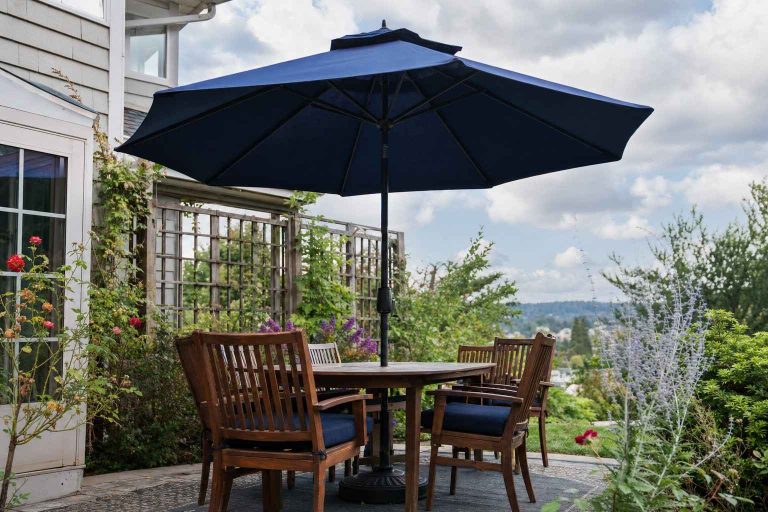
A table umbrella runs a single pole straight down through the hole in a patio table. Most outdoor tables use a standard 1.75 inch pole hole, so check that measurement before anything else.

Some table umbrellas add a tilt joint too, letting the canopy angle toward low afternoon sun without repositioning the whole stand.

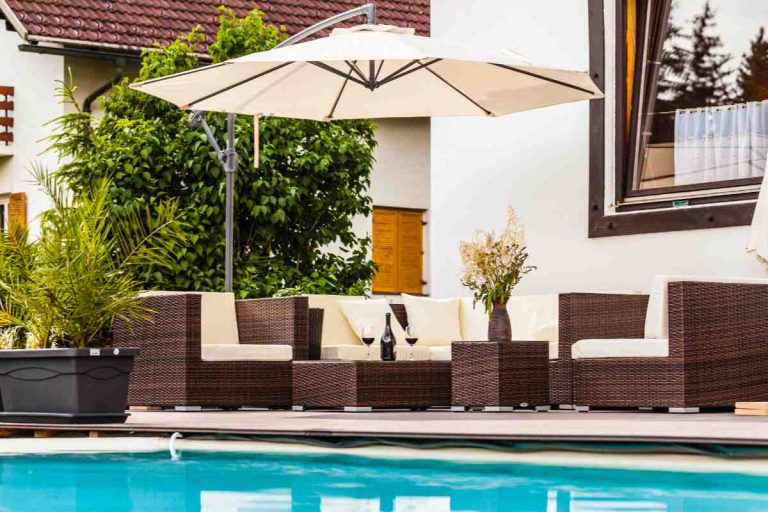
A freestanding or offset umbrella clears the floor entirely instead. The canopy hangs off a cantilever arm rather than a center pole.
That is why it works over a sofa, a bar cart, or a patch of lawn with nothing underneath it. Many offset models also tilt and rotate through a full circle to track the sun.
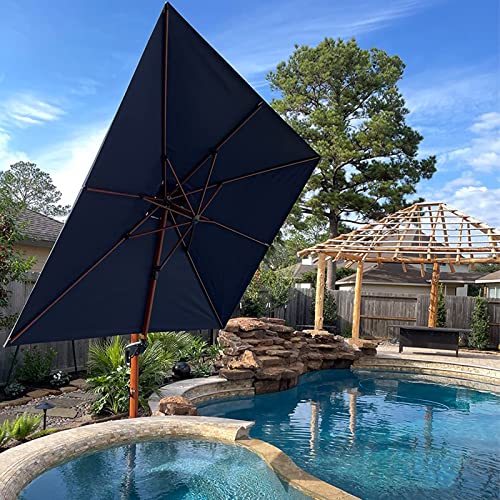
The full breakdown of when each style wins, including the base weight each one demands, is in the offset vs. market umbrella comparison.
If a table with a hole already exists where you want shade, that decides it: buy the market or table-mount style. If the space has no table or pole underneath it, the freestanding route is the one to shop. The top picks in our offset patio umbrella roundup are the place to start.
Sizing the canopy to your space
The canopy needs to match the table, not just look big on the shelf. The rule of thumb: it should extend past the table’s edge by about two feet on every side.
A table 30 to 36 inches across wants a 6 to 8 foot canopy. A table 38 to 48 inches wants 9 to 11 feet. Anything 54 inches or larger wants 11 feet or more.
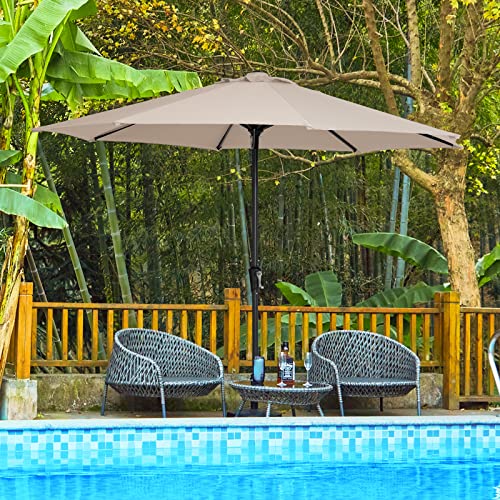
Height matters just as much as width. Look for at least 7 feet of clearance so nobody has to duck under the canopy. It should not be so tall that the shade falls past the table instead of over it.
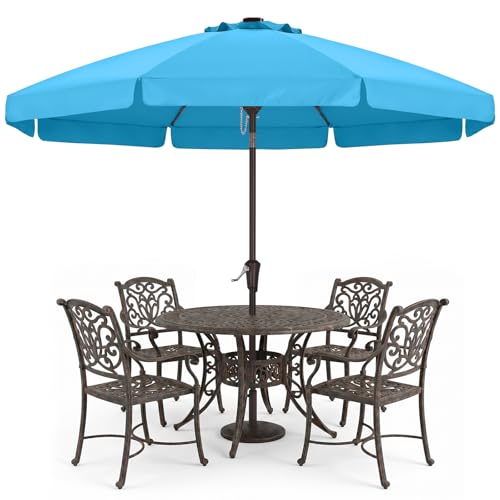
Getting this measurement wrong is the single most common umbrella-buying mistake, and it is also the easiest to avoid. The step-by-step guide to measuring a patio umbrella covers rib length and crank height. It also shows how to size a replacement canopy if the frame is still good.
The base weight most buyers skip
An umbrella does not tip because the wind was unusually strong. It tips because the base was too light for the umbrella sitting on top of it.
Base weight follows the mount type chosen above. A table umbrella can lean on the table for help, so roughly 50 pounds covers it.
A freestanding umbrella has nothing sharing the load, so the target moves closer to 80 pounds. An offset or cantilever design multiplies the tipping force through its cantilever arm. That is why those bases run 150 pounds or more.
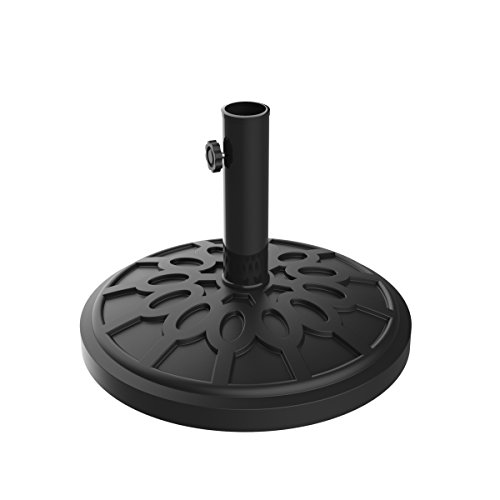
The full weight class breakdown for each mount type, plus the specific bases that hit each number, is in the patio umbrella base weight guide.
If the yard is unusually exposed (a corner lot, a hilltop, near open water), treat the numbers above as a floor, not a ceiling. The wind-resistant umbrella roundup covers canopy vents, frame gauge, and the extra base weight an exposed spot actually needs.
Not every tipping problem needs an entirely new base. If the current one is close but not quite enough, adding weight directly can close the gap.
A plate-style or bag-style add-on is the cheapest fix in this whole guide. It solves a near-miss without a full base swap.
In case you need extra weight, something like Gravipod is a weight bag that straps onto a stand and fills with sand for extra security.

Fabric and frame materials that last
Canopy fabric and frame metal decide how many summers the umbrella survives, not just how it looks in the box. Look for solution-dyed polyester in the 200 to 250 GSM range.
It resists fading and holds up to rain far better than a thin, piece-dyed cover. A UPF 50+ rating blocks most of the sun the umbrella is there to block in the first place.
- Fabric: solution-dyed polyester, 200 to 250 GSM, UPF 50+ for fade and sun resistance.
- Frame: aluminum for light weight and rust resistance, or powder-coated steel for extra strength.
The frame matters just as much as the fabric. Powder-coated steel needs to dry off after rain so it does not scratch through to bare metal.
Both specs matter more on an offset or cantilever umbrella, since the cantilever arm puts more stress on the frame than a straight center pole. A vented canopy also helps here, letting wind pass through the top instead of catching the whole surface like a sail.
The material and frame sections of our offset patio umbrella roundup compare fabric weight and frame metal across the current lineup, model by model.
Quick routing table
The four questions above cover the decision. This table is the shortcut once the decision is made.
Match your situation to the guide and skip straight to the part that matters.
| Situation | Read this |
|---|---|
| Deciding between a table mount and a freestanding umbrella | Offset vs. Market Umbrella |
| Sizing the canopy to a table or open space | How to Measure the Size of a Patio Umbrella |
| Picking base weight for your mount type | Best Patio Umbrella Bases |
| Shopping for a windy or exposed spot | Best Patio Umbrella for Wind |
| Shopping the freestanding or offset route | 11 Top Offset Patio Umbrellas |
| Umbrella already broken, stuck, or wobbly | How to Fix a Patio Umbrella |
Keep it alive once you own it
A patio umbrella earns its price by staying up and staying open, year after year.
Most failures are mechanical, not structural: a stuck crank, a bent rib, a snapped string, a base that has come loose. None of them usually need a whole new umbrella.
Regular care stretches the list even further. Clean the canopy every few months, and dry the frame after rain.
Close the umbrella before a real storm rolls through, even a good one. Wind is what breaks ribs, not sun.
When something stops working the way it should, the DIY patio umbrella repair guide walks through the fix for each common problem. Read it before the umbrella becomes a reason to shop for a replacement.