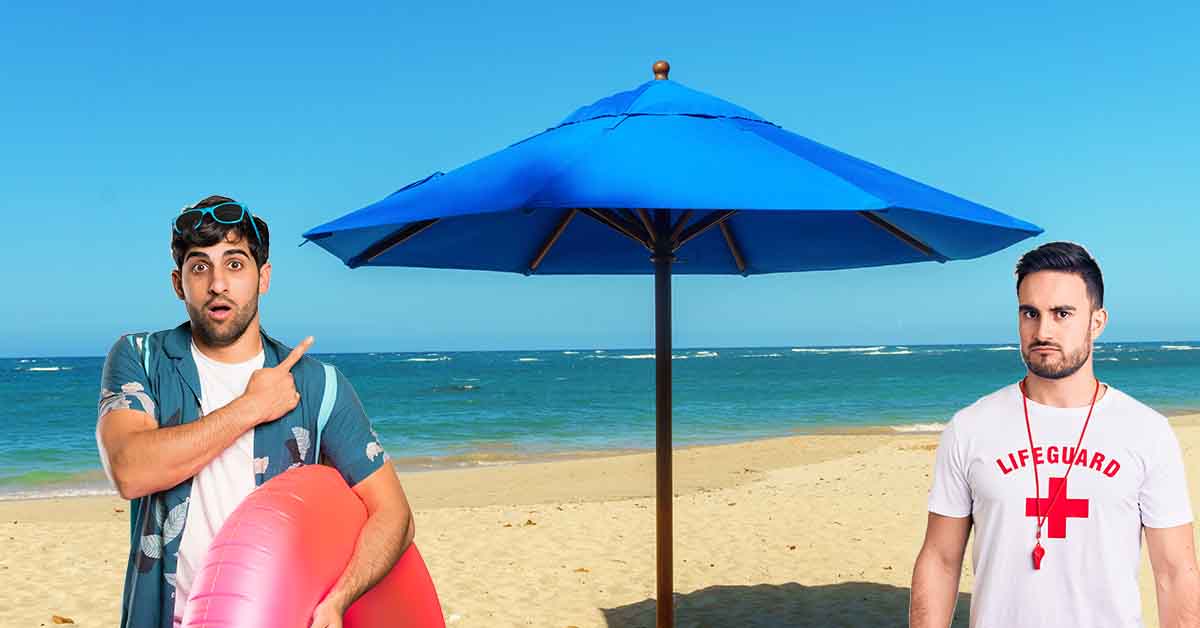
Can You Use a Patio Umbrella at the Beach?
A patio umbrella can technically make the trip to the beach. Almost nothing about it was built for the job.
Reader-supported: if you buy through links on this page we may earn a small commission, at no extra cost to you.
The base stays home unless you carry it too. The pole cannot use the one anchoring trick that actually works in loose sand.
That does not make it impossible. It just means more work than a real beach umbrella would ask of you.
Here is exactly where the friction shows up.
Where a Patio Umbrella Struggles at the Beach
The problems are structural, not cosmetic.
A patio umbrella’s pole, base, and canopy were all built around a hard, flat surface. Sand moves. Concrete and table tops do not.
| Problem | Why it happens | What it means at the beach |
|---|---|---|
| No sand anchor | Pole has a flat or threaded bottom built for a base socket | Nothing to spike into the sand; it needs a base you carry too |
| Base is dead weight | Concrete or fillable bases run 30 to 80+ pounds | You are hauling a second heavy item across the sand |
| Wide pole diameter | Sized for a table hole or base collar, roughly 1.5 to 2 inches | Too thick for the screw-in sand anchors made for beach umbrellas |
| No easy repositioning | Base has to be reset and re-leveled to move it | You cannot chase the shade as the sun moves |
Every row on that list traces back to the same design choice. A patio umbrella was built to stay put, not to travel.
The Anchoring Problem Is the Real Dealbreaker
A patio umbrella has no sand anchor because it was never supposed to need one. At home, the pole drops into a table hole or a base and stays there.
On sand, that base still has to come with you. Setting a heavy concrete base level on loose sand is its own project, before the umbrella is even open.
Beach umbrellas skip that step. A pointed or screw style tip is built right into the pole, thin enough to twist into sand by hand.
A patio umbrella pole is sized the opposite way. It has to fit snugly inside a table hole or a base collar, which puts it around 1.5 to 2 inches across.
That is too wide for the screw-in sand anchors made for beach umbrellas.
You Cannot Chase the Sun With It
On a patio, you set the base once and leave it. The shade only needs to shift a little over the day, and the table usually blocks the worst of it anyway.
Open sand is different. The sun moves fast enough that you will want to shift the umbrella every hour or two.
A beach umbrella is built for exactly that move: pull it, walk it a few feet, spike it again. A patio umbrella’s base turns the same move into a two person job.
Most people just leave it in one spot instead, and let the shade wander off the towels.
When a Patio Umbrella Actually Works at the Beach
It is not a flat no. A patio umbrella can genuinely work in a narrow set of conditions.
- A calm day with no real wind. The stability problem mostly comes from wind catching an unanchored canopy. Without much wind, an unanchored umbrella is just heavy, not dangerous.
- A base you are already bringing. If you are hauling a cooler, chairs, and a wagon anyway, one more item is not a new category of problem. The guide to patio umbrella bases covers which weight class actually holds an umbrella upright on sand.
- A deck or boardwalk near the beach. Plenty of beach houses and rentals have a deck within sight of the water. That is a patio, not a beach, and the umbrella is exactly where it belongs.
Outside those conditions, the umbrella fights the setting more than it helps you enjoy it.
What a Real Beach Umbrella Does Differently
A beach umbrella is built around the one thing a patio umbrella ignores: loose, moving ground.
The pole is thinner, because it only has to hold itself up in sand, not lock rigidly into a table.
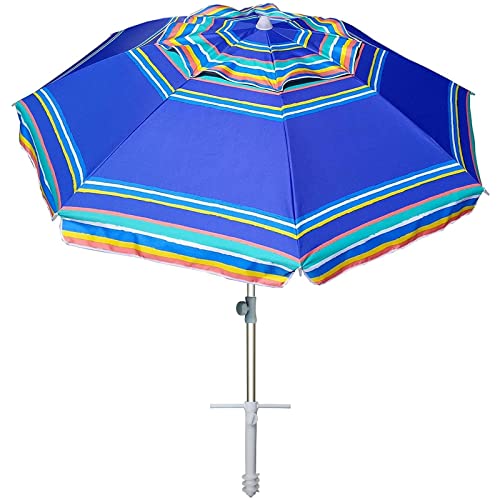
That thinner pole ends in a point or a screw anchor. It is the anchoring trick a patio umbrella’s flat bottomed pole cannot use.
The canopy is lighter, too, and the whole umbrella folds down small. Small enough to carry in one hand, which is why a beach umbrella like the one below packs closer to carry-on luggage than patio furniture.
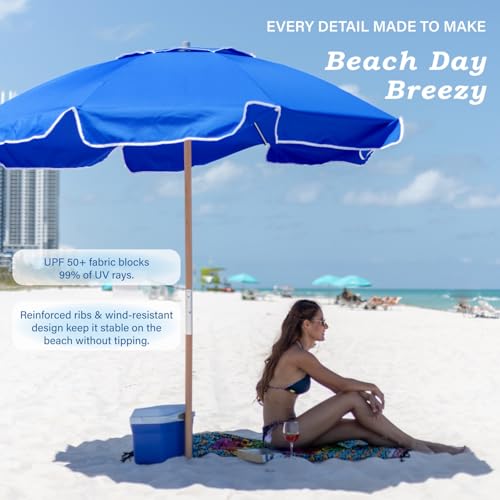
None of that makes a beach umbrella better on the patio. It just means the two are built for opposite jobs.
The Bottom Line
Bringing a patio umbrella to the beach is possible, not practical. The base has to travel with it. The pole cannot use a sand anchor. Repositioning it as the sun moves means resetting the whole thing by hand.
On a calm day, with a base you are already carrying, it can work well enough.
Anywhere windier, or for a regular beach trip, a real beach umbrella earns its keep in the first five minutes of setup. The mismatch runs the same direction the other way too, as the question of using a beach umbrella on a patio table makes just as clear.