How to Fix a Patio Umbrella: Repairs for Every Common Problem
Most patio umbrella problems come down to one of five things: a stuck crank, a bent or detached rib, a snapped string, torn fabric, or a loose base.
Match your problem to the list and you are already halfway to the fix.
None of them need a new umbrella.
Match the symptom below to the fix and work from there.
Reader-supported: if you buy through links on this page we may earn a small commission, at no extra cost to you.
An umbrella earns its keep by staying up and staying open.
The moment it stops doing either, it is worth ten minutes with a screwdriver before it is worth a trip to the store.
Almost every failure below is mechanical, not structural. Most are fixable in an afternoon with tools already in the garage.
Find Your Symptom
| Symptom | Likely cause | Fix |
|---|---|---|
| Won’t open or close | Crank gear worn or jammed, or the runner is stuck on the pole | Check the crank mechanism |
| Crank turns with no resistance | Gear teeth inside the crank housing have stripped smooth | Replace the crank unit |
| Rib or spoke bent or detached | Wind stress or a hard close snapped the joint | Straighten or swap the rib |
| Canopy suddenly goes slack | The string inside the pole has snapped | Restring the umbrella |
| Fabric tear or seam split | Sun exposure breaking down the material, or a snag | Patch or replace the canopy |
| Won’t tilt or stay tilted | Tilt gear stripped or the locking pin is dislodged | Reset or replace the tilt joint |
| Pole wobbles in the base | Base too light, or the collar around the pole has worn loose | Tighten the collar or upgrade the base |
Umbrella Won’t Open or Close
Nine times out of ten this is the crank mechanism, not the ribs.
Turn the handle and feel for where it binds.
If it will not turn at all, something is jammed rather than broken. Forcing it usually bends a rib before it frees the crank.
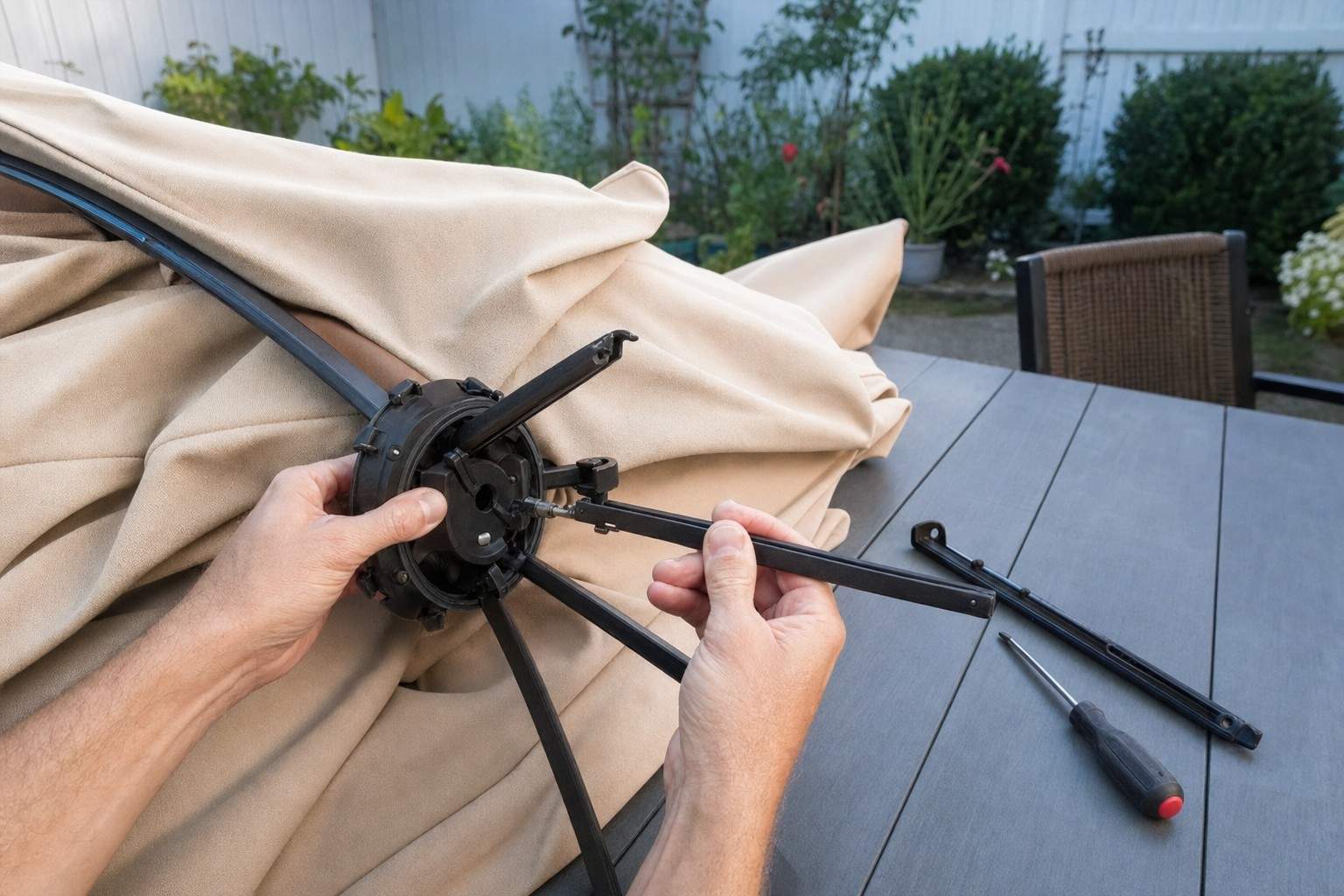
Unscrew the cap on the underside of the canopy hub to expose the gears.
Look for a rib that has slipped off its track and is wedging the mechanism, and reseat it by hand.
If the gears are gummed up with old grease and grit, wipe them clean and add a drop of silicone lubricant.
A screwdriver and a rag cover this repair.
If a gear tooth is visibly chipped rather than just dirty, the crank needs replacing rather than cleaning. That is the next symptom.
Crank Turns With No Resistance
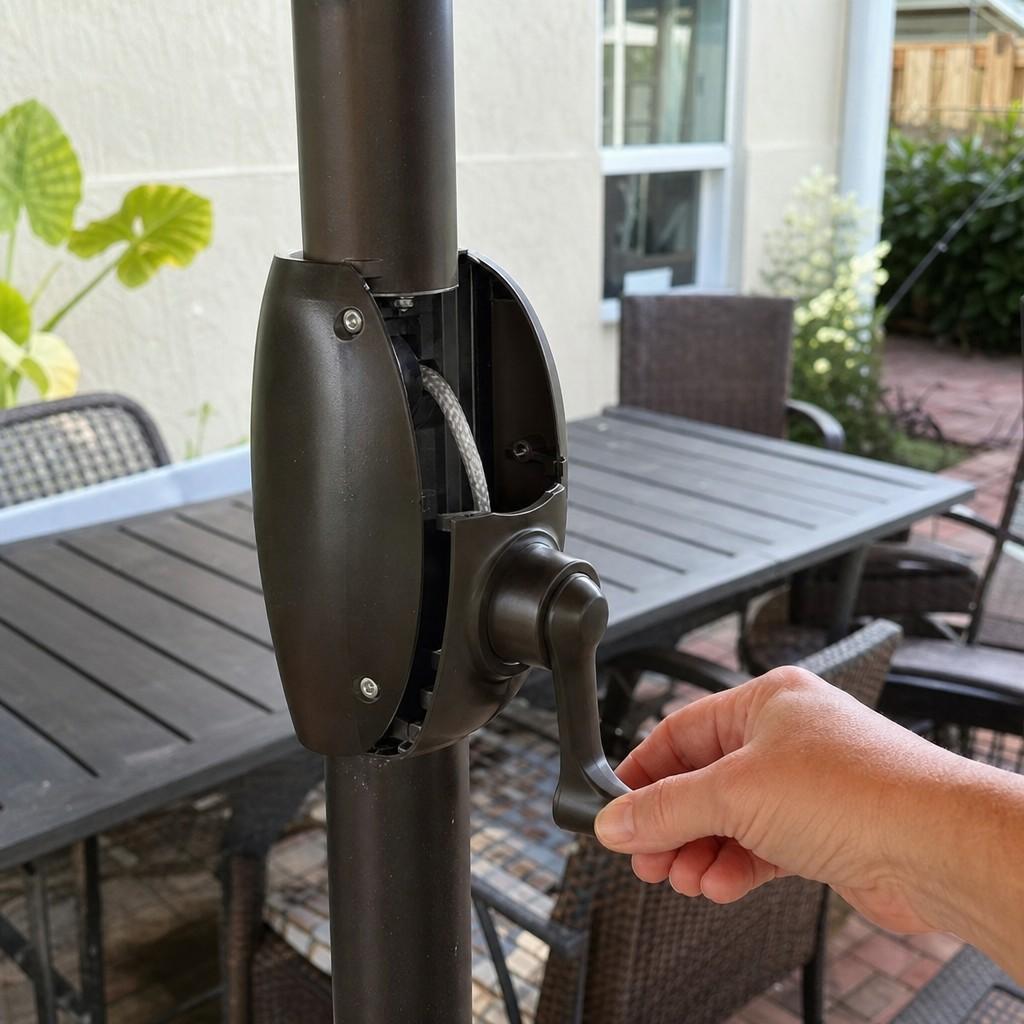
If the handle spins freely and the canopy never rises, the gear teeth inside the crank housing have worn smooth.
That is a parts swap, not a cleaning job. No amount of lubricant fixes stripped metal.
Replacement crank units are inexpensive and sold to fit common pole diameters.
Measure the pole where the crank housing sits before ordering one.
Remove the old unit with a screwdriver and note how the cable or string feeds through it, then thread the new one the same way.
Bent or Detached Rib
The ribs hold the fabric shape and take the brunt of any gust, so they are the part most likely to bend.
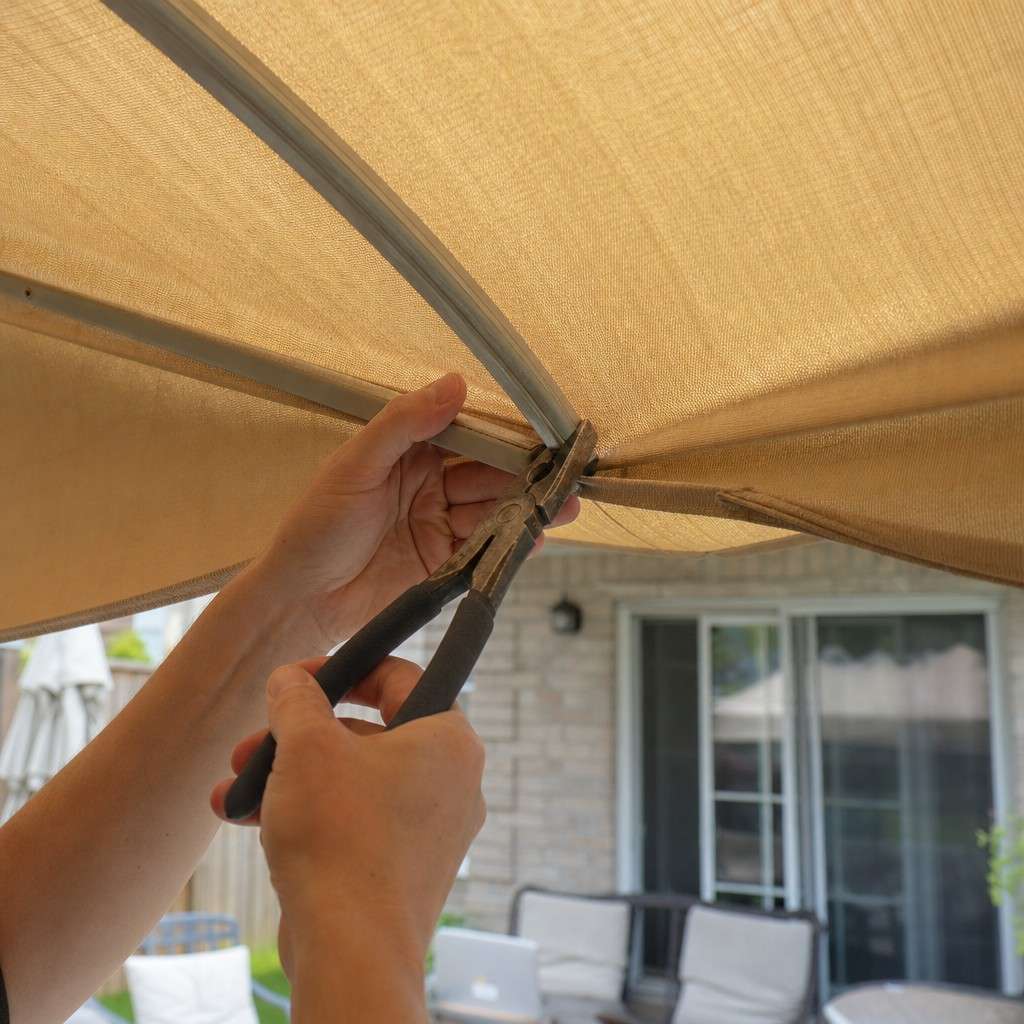
A rib that is bent but still attached can usually be straightened by hand or with pliers.
Work slowly so the metal does not crack at the bend.
A rib that has popped off the frame entirely needs to be reseated at the hub joint.
Check afterward that it opens and folds the same as the ribs beside it.
A rib that snaps clean through has to be replaced, not straightened.
Slide the broken piece out from the end cap and measure it.
Match the replacement to the umbrella’s pole and canopy size before buying.
Tools: a screwdriver for the end cap, pliers for bending, and a tape measure so the replacement rib actually fits.
Canopy Suddenly Goes Slack
If the whole canopy loses tension at once instead of one panel sagging, the string has broken.
That string runs through the pole and out to each rib tip.
It is a common failure on umbrellas that get opened and closed roughly, since that string takes the load every time.
This one is a full restring, not a quick patch.
Walking through it properly takes more room than a paragraph here does.
Feeding the new cord through the pole and tensioning it correctly takes real step-by-step detail. That detail lives in our dedicated guide to restringing a patio umbrella.
Torn Fabric or Split Seam
Sun exposure is what actually kills most umbrella fabric.
UV breaks down the fibers over a season or two. What looks like a random tear is often the material giving out at its weakest point.
For a tear under a few inches, clean the area with mild soap and let it dry fully before repairing anything.
A vinyl repair kit handles most small tears.
Cut a patch a little larger than the damage, apply the adhesive to the underside of the fabric, and press it into place.
A seam that has split along the stitching is a sewing repair, not a patch job.
A heavy-duty needle and outdoor-rated thread can close it.
A tear that keeps growing or spans multiple panels usually means the whole canopy is due for replacement rather than another patch.
Umbrella Won’t Tilt or Stay Tilted
Tilting umbrellas use either a crank-tilt gear or a push-button pin, and both fail in predictable ways.
On a crank-tilt model, the same stripped-gear problem that jams the opening mechanism can also jam the tilt.
The fix is the same: inspect the gear, clean it, and replace the housing if the teeth are chewed up.
On a push-button model, the tilt usually fails because the locking pin has slipped out of alignment with its socket.
Loosen the collar around the pole, work the joint back into position by hand, and retighten before testing it.
If the pin itself is bent or missing, it is a small, inexpensive part to replace. That is not a reason to replace the umbrella.
Pole Wobbles in the Base
A pole that rocks in its base usually has one of two causes.
Either the collar or set knob that grips the pole has worn loose, or the base itself is too light for the umbrella.
Start with the collar, since it is the cheaper fix.
Tighten the set screw or knob. If the fit is still sloppy, an umbrella cone wedge takes up the extra gap.
A wobble that survives a tightened collar is a base problem, not a pole problem.
That gets into weight classes and base types rather than a single repair step. It is covered in full in our guide to keeping a patio umbrella from falling over.
When Repair Is Not Worth It
Most umbrella problems are worth fixing. A couple are not.
A bent center pole is a retire-it signal, not a fix-it one.
The center pole is what every rib, the crank, and the canopy all attach to.
Once it bends, nothing sits square again, and straightening it enough to matter usually cracks the metal or throws the whole mechanism out of alignment.
Multiple broken ribs on a budget umbrella add up the same way.
Replacing one rib is a ten-minute job.
Replacing three or four on a frame that cost forty dollars new is not worth the parts or the time. The risk of a mismatched fit adds to the case for just replacing it.
Preventing the Next Repair
Most of the failures above trace back to two habits, and both are free to fix.
Take the umbrella down before wind picks up, not after it has already started tipping.
A closed umbrella puts almost no load on the ribs or the tilt mechanism, while an open one catches every gust like a sail.
If storms are common where you live, closing it whenever you leave the yard beats replacing ribs every season.
A canopy cover does the rest of the work when the umbrella stays up between uses.
It keeps direct UV off the fabric between sits, which is the single biggest reason the material lasts or does not.
It also keeps grit out of the crank and tilt mechanisms that otherwise jam the moment you need them.