
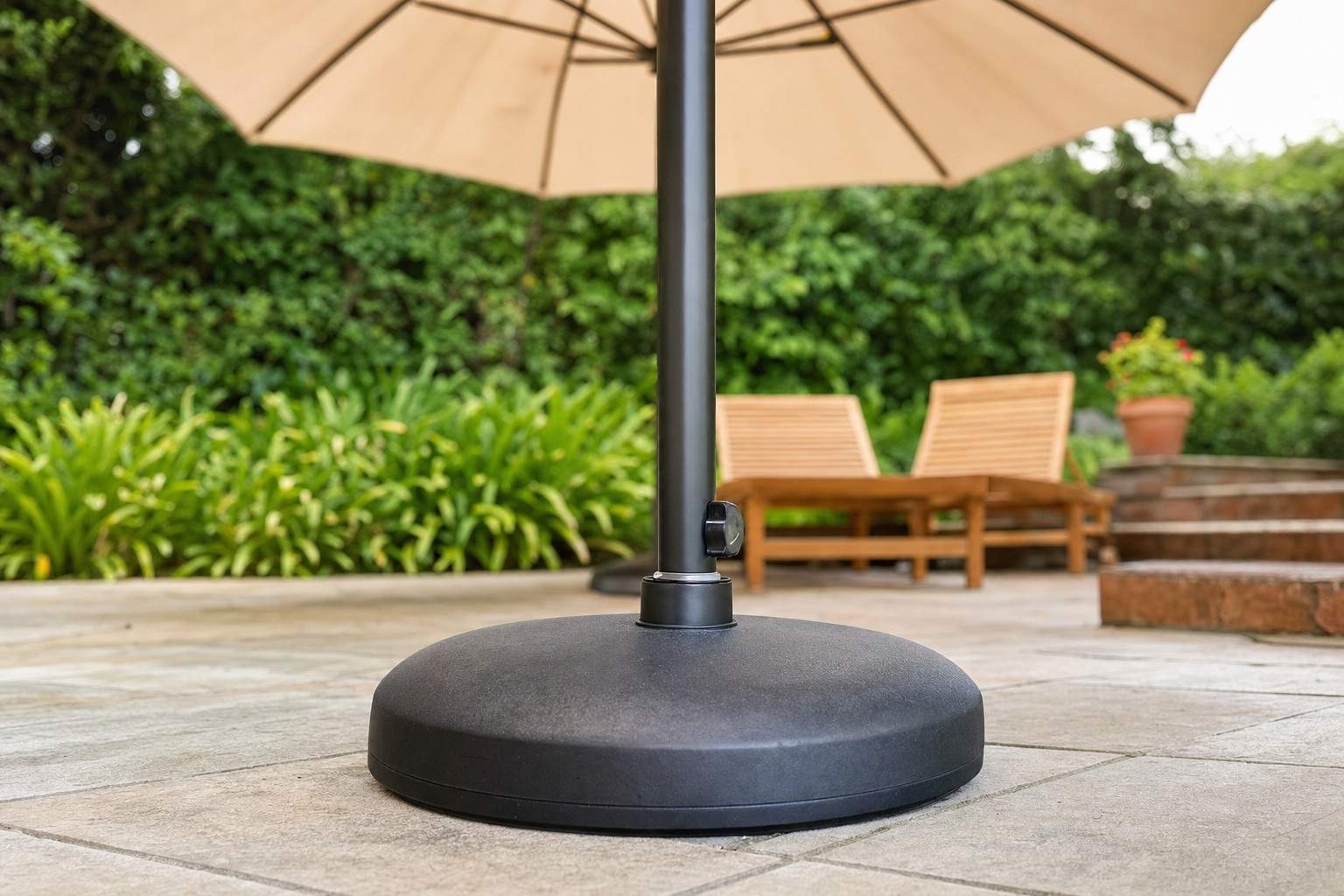
Best Patio Umbrella Bases: How Heavy Does Yours Need to Be?
An umbrella does not tip because the wind was unusually strong. It tips because the base was too light for the umbrella sitting on top of it.
That is the entire problem, and it has a straightforward answer. Base weight is the one spec that decides whether the umbrella stays put or ends up on its side in the yard.
Reader-supported: if you buy through links on this page we may earn a small commission, at no extra cost to you.
Every umbrella setup falls into one of a handful of situations: through a table, freestanding, offset, or mobile. Each one has a matching weight class, and once you know which situation you are in, the shopping list gets short fast.
Match the base to the umbrella, not the umbrella to whatever base happened to be on sale.
Umbrella through a table: the 50-pound class
A table-mounted umbrella has help. The table itself resists tipping, so the base does not have to do the whole job alone.
That is why the 50-pound class is the standard here, not an upgrade. A round concrete base with a steel shell gives enough ballast to hold a center-pole umbrella steady while the table shares the load.
Look for a tall receiver pole with a set knob so the umbrella pole locks in rather than wobbling in the socket.


The California Umbrella base fits this class exactly. It weighs 50 pounds, pairs a concrete core with a powder-coated steel shell, and its 16-inch receiver pole includes a security set knob to hold the umbrella pole in place. With 19 inches of clearance, it tucks under a table without crowding legs or chairs.
Freestanding market umbrella: fillable bases
Pull the table out of the equation and the math changes. A freestanding umbrella has nothing helping it resist wind, so it needs meaningfully more weight than the under-table class.
Roughly 80 pounds is the practical target for a standalone market umbrella. A freestanding patio umbrella works fine without a table underneath it, but only if the base is built for that job.
Fillable bases solve the shipping problem here. They arrive light as empty plastic and get their weight from water or sand once in place, keeping freight costs down.

The JEAREY base fills to about 81.5 pounds at capacity. It is made of HDPE plastic, so it will not rust the way a steel base can, and a galvanized steel pipe inside fits standard market umbrella poles. Two locking knobs keep the pole from spinning or sliding once it is set.
Offset and cantilever umbrellas: plate sets
An offset umbrella changes the physics. The canopy hangs out to the side instead of sitting over the pole, and that leverage multiplies the tipping force.
That is why offset bases run roughly three times heavier than a center-pole freestanding setup. A single unit that size would be nearly impossible to move, so most offset bases split the weight across several fillable plates.
Anyone shopping for an offset patio umbrella should plan on this heavier base category from the start.

This four-piece plate set reaches 174 pounds of total capacity when every plate is filled. Each plate holds up to 38.9 pounds of sand or 13.2 liters of water, and interconnecting pins lock the plates together so they act as one solid base. Fill spouts with twist caps make loading each plate straightforward.
If you move the umbrella around: a base on wheels
Some setups need to shift with the sun or come apart for storage. A wheeled base makes that realistic instead of a two-person moving job.
The tradeoff is usually a lower maximum fill than the heaviest fixed bases, so a mobile base suits a market umbrella more than a large offset canopy.

This mobile base takes up to 120 pounds of sand or 38 liters of water. Four wheels let one person roll it between spots, and two wheel locks hold it in place once it is positioned. Tightening knobs secure the umbrella pole itself.
If your current base tips: add a weight bag
Not every tipping problem needs a whole new base. If the current one is close but not quite enough, adding weight directly can fix it.

The Rhino BaseMate is an 18-inch weight bag made of tear-resistant 900D fabric with reinforced sides. A side opening makes it easy to position around an existing base, and it fits both offset and regular base styles.
What to look for
- Weight class by umbrella type. Roughly 50 pounds for under a table, about 80 for freestanding, 150 or more for offset and cantilever.
- Fillable versus solid. Fillable bases ship lighter and cheaper, then reach full weight with sand or water on site.
- Receiver pole fit and knobs. A set knob or locking knob keeps the umbrella pole from spinning or sliding loose.
- Wheels only if you actually move it. Wheels add convenience but are not worth the tradeoff for a base that stays in one spot.
- Under-table clearance. Measure the base height against your table legs and chair arms before ordering, and check the umbrella’s overall size against the space it needs to cover.
The short version
Fifty pounds covers a table-mounted umbrella because the table shares the load. Roughly 80 pounds is the target once the umbrella stands on its own with no table to help.
Offset and cantilever umbrellas need 150 pounds or more, split across plates, because the canopy’s leverage is far greater than a center-pole design.
If tipping is already happening and buying a new base feels like overkill, a weight bag added to your current setup often closes the gap. For anyone still fighting wind with an undersized base, the guide on keeping a patio umbrella from falling over covers the rest of the fix.