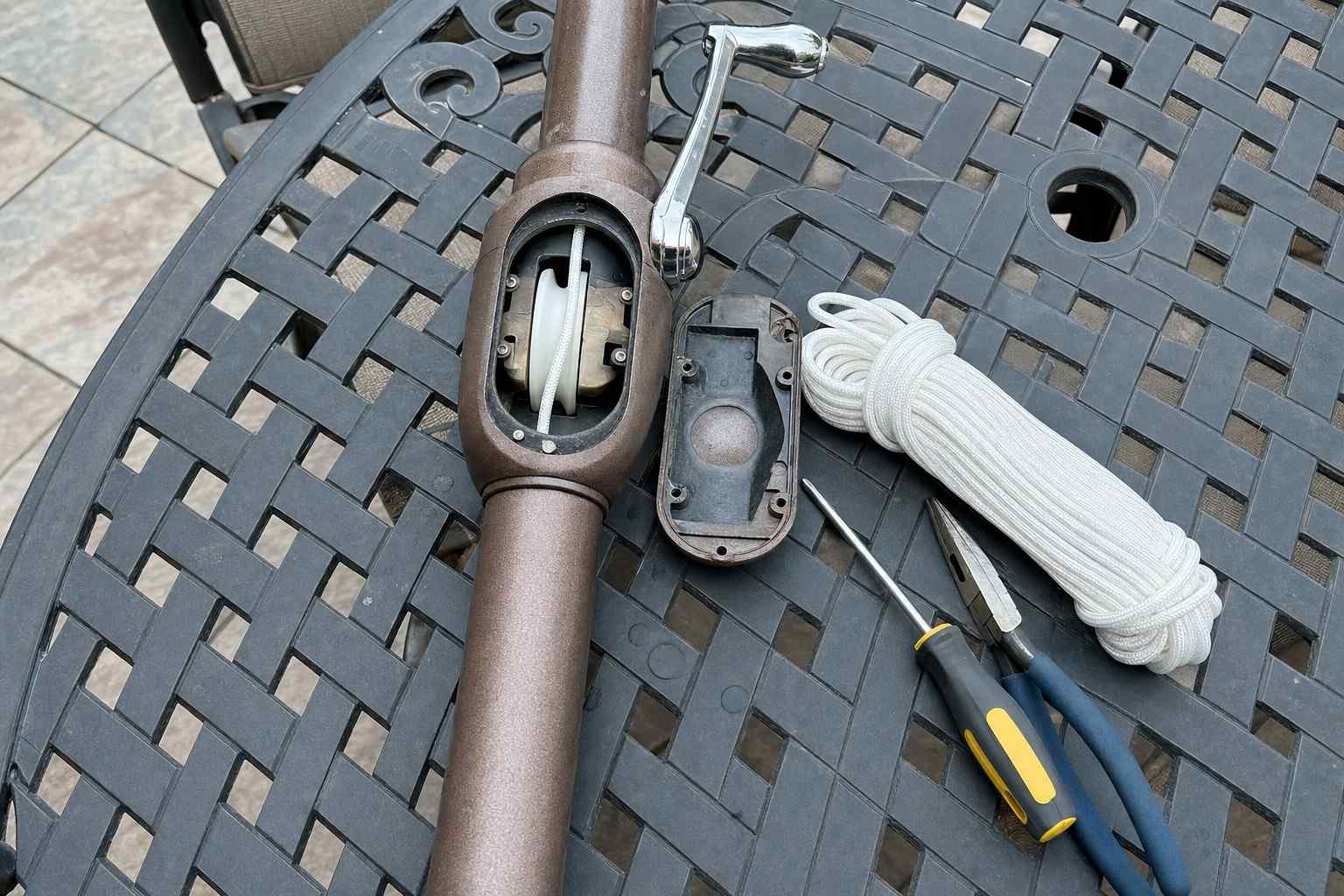
How to Restring a Patio Umbrella: A Step by Step Repair Guide
If your umbrella’s canopy suddenly goes loose all over, instead of sagging in one spot, the cord running through the pole has snapped.
That is a restringing job, and it is well within reach for a DIY afternoon. You need a length of replacement cord, basic hand tools, and enough patience to work slowly.
Reader-supported: if you buy through links on this page we may earn a small commission, at no extra cost to you.
Something else might be wrong while your canopy stays taut, like a stuck crank or torn fabric. Our guide to fixing a patio umbrella walks through the rest of the common failures.
What You Need
A restringing job uses ordinary tools, nothing specialized.
- A screwdriver, to open the hub cap and end caps
- Pliers, for stubborn knots and old cord
- Scissors, to cut the new cord to length
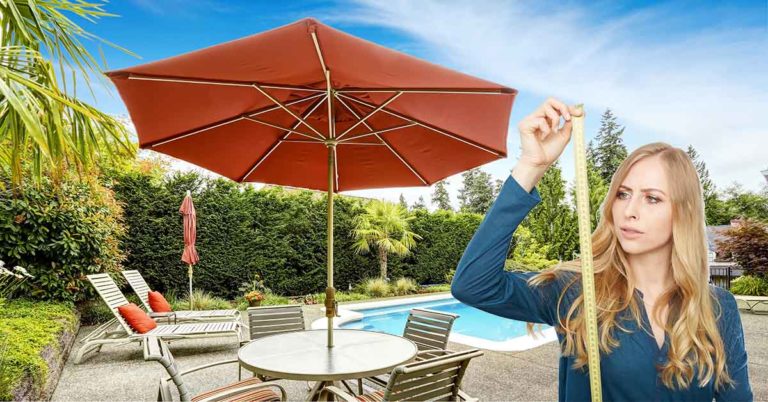
- A tape measure
- A replacement umbrella cord rated for outdoor use, matched to the old cord’s diameter
- A phone camera or a notepad, to record how the old cord was routed
Buy the cord before you start taking anything apart.
Ordering mid-job means an open umbrella sitting in pieces for a few days.
Open the Hub and Map the Old Path
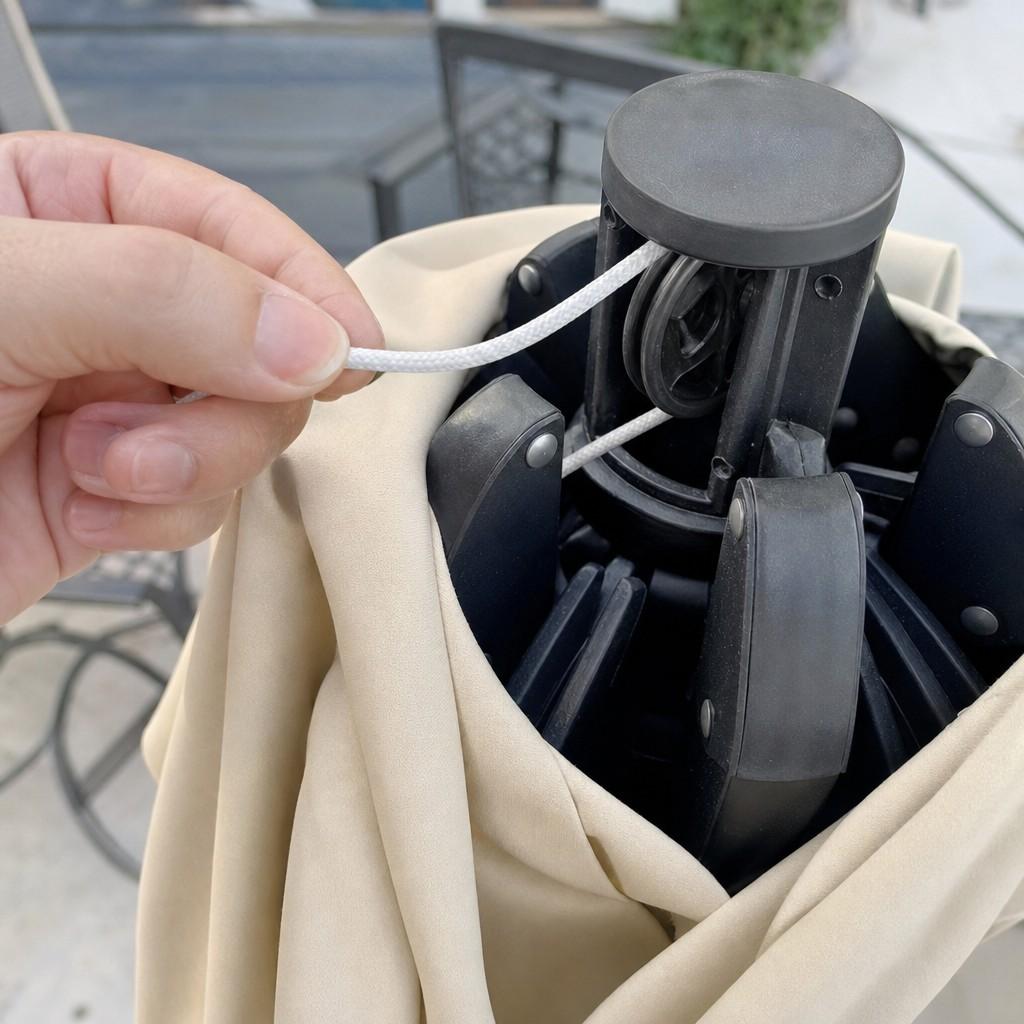
Unscrew the cap on top of the pole. This exposes the hub where all the ribs meet.
Before you touch the old cord, photograph exactly how it runs. Trace it from the hub, down through the pole, and back out to each rib tip.
This step is the one people skip and regret.
Umbrellas route cord differently by mechanism. Guessing the path afterward wastes more time than the photo takes.

Image by lifeforstock on Freepik
Pull the Old Cord and Measure the New One
With the path recorded, gently pull the broken cord free.
Work slowly if there are knots or tangles left over from the break.
Yanking a stuck section can damage the pulleys or the rib joints.
While the umbrella is apart, check each rib and the frame for cracks, rust, or looseness. It is far easier to fix those now than after the new cord is already threaded.
Measure the old cord’s length, then add about six inches.
That extra length gives you slack to tie secure knots at both ends without running short. Cut the new cord to that measurement.
Feed the Cord Through the Hub and Pulleys
This is where the photo from step one earns its keep. Thread the new cord through the hub the same way the old one ran, then out through the pulleys toward the rib tips.
Most residential umbrellas use one of two setups.
A single pulley routes the cord straight from the hub to the ribs in one pass. A double pulley redirects the cord partway instead, which is common on umbrellas with a crank. The crank needs the cord looped back on itself to wind it in.
You do not need to know which type you have before you start. The routing is the same either way: follow the path the old cord took, and the pulleys guide the cord through it.
Keep the cord taut as you feed it so it does not bunch up inside the pole.
Tie Off and Test Slowly
Once the cord reaches every rib tip, tie it off at the hub with a secure knot and trim the excess.
Open and close the umbrella slowly the first few times, not with a full crank turn. Watch for any rib that stays slack or a section that binds.
A cord that is tensioned unevenly usually shows up on the first open.
If the mechanism feels stiffer than it should, add a drop of silicone lubricant to the pulleys and hub. It helps the new cord slide the way the old one did before it wore out.
Once it opens, closes, and holds tension across every rib, the job is done.
A large market umbrella is easier to restring with a second set of hands. One person can hold the pole steady while the other feeds and tensions the cord.
Is This a Hard Repair?
Restringing is fiddly, not difficult. The parts themselves are simple.
The patience is in threading the cord through a narrow pole without losing track of the path. That is exactly why mapping it first matters so much.
Most people finish in under an hour once the umbrella is open on a flat surface with good light.
The job changes if the pulley itself is broken, not just the cord. A snapped cord is a restring.
A cracked or seized pulley wheel is a parts swap, and the mechanism has to come apart further to reach it.
If turning the crank feels loose or grinds with no resistance, that points to worn gear teeth rather than a cord problem. Our guide to fixing a patio umbrella covers that repair separately.
A local pro typically charges $50 to $150 for a restring, depending on the umbrella’s size and how it comes apart. The cord itself costs a small fraction of that, which is the real case for doing it yourself.
Preventing the Next Snapped Cord
The cord takes load every time the umbrella opens or closes, so a couple of habits make it last longer.
Open and close the umbrella smoothly rather than forcing a stuck crank. Forcing a jam is what snaps a cord that was otherwise fine.
Clean and lubricate the mechanism before it gets gritty enough to strain the cord.
A little silicone spray on the hub and pulleys once or twice a season keeps everything moving freely.
Close the umbrella before storms rather than after the wind has already started pulling at it.
A closed umbrella puts no load on the cord at all. An open one is constantly working against it.
This is a different mechanism from the tilt joint, on umbrellas that also tilt. Tilting uses its own separate adjustment, covered in our guide to tilting a patio umbrella.